
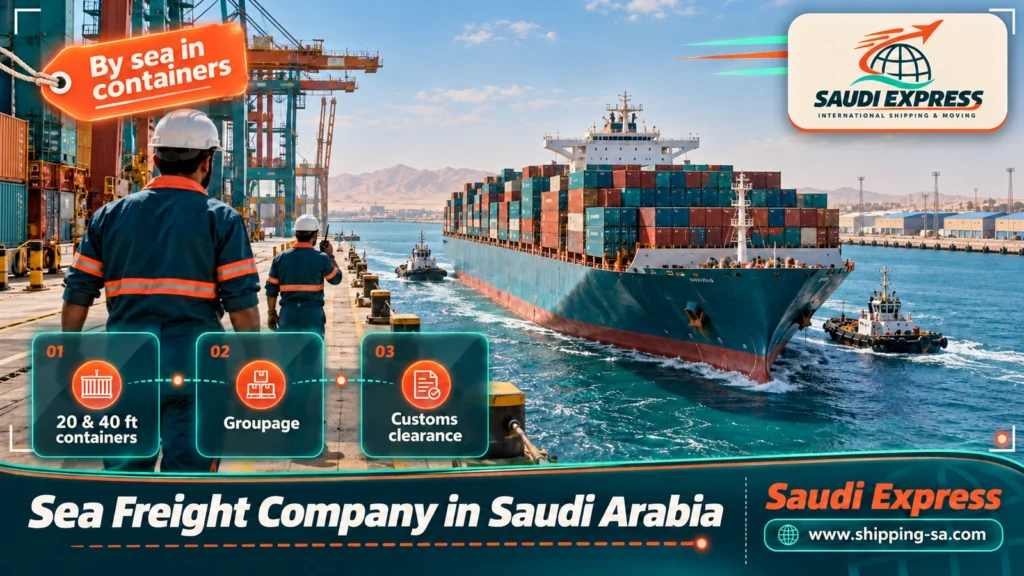
Saudi Express is a sea freight company in Saudi Arabia shipping full and shared containers, cars, furniture and goods from Jeddah Islamic Port, King Abdulaziz Port in Dammam and other Saudi ports to Turkey, the Levant, North Africa, Egypt, Sudan, Europe and Asia, with pickup from your door, packing, clearance at both ports and delivery. A 20 ft container starts from SAR 4,460, a 40 ft from SAR 7,160 and shared freight from SAR 185 per cubic metre. Call or WhatsApp 0560533140.
In short
- Ports: Jeddah Islamic Port on the Red Sea, King Abdulaziz Port in Dammam on the Arabian Gulf, plus Jubail, Yanbu and Jazan
- Containers: 20 ft about 33 m³, 40 ft about 67 m³, high cube about 76 m³
- Prices: 20 ft container from SAR 4,460, 40 ft from SAR 7,160
- Shared (LCL): from SAR 185 per cubic metre for small shipments
- Cars: RoRo or in a container, from SAR 6,030
- Transit: days to nearby ports, 2 to 5 weeks to North Africa, Europe and Asia
What is sea freight and who is it for?
Sea freight moves goods, furniture and cars in containers or on dedicated vessels from one port to another, and it is the most economical way to send large volumes to countries without a practical road link, such as Turkey, North Africa, Europe, Asia and the Americas. What a customer pays for one container can cover a whole home’s furniture, while the same weight by air costs many times more.
Sea freight suits three groups: families moving home to a distant country, traders and factories importing and exporting in volume, and anyone shipping a car beyond the Arabian Peninsula. Small urgent shipments belong in air freight, and for the Gulf, Jordan and Iraq the closer, faster option is land freight.
The core difference between sea and other modes is time against cost: the ship is slower but carries thousands of containers per voyage, so the cost per cubic metre falls to a fraction of air. That is why people shipping by sea plan weeks ahead and send whatever they need immediately another way.
Saudi ports we ship from
We ship from the main Saudi ports on the Red Sea and the Arabian Gulf, choosing the port by destination and pickup location: Red Sea ports are closer to the Suez Canal, Europe and Africa, while Gulf ports are closer to Asia, India and the Gulf.
| Port | Coast | Usually serves | Common destinations |
|---|---|---|---|
| Jeddah Islamic Port | Red Sea | Jeddah, Makkah, Madinah, the south and Riyadh | Turkey, Egypt, Sudan, the Levant, North Africa, Europe |
| King Abdulaziz Port, Dammam | Arabian Gulf | Eastern Province, Riyadh and Qassim | Asia, India, Pakistan, the Gulf, East Africa |
| Jubail Commercial Port | Arabian Gulf | Jubail and nearby industry | Asia and the Gulf |
| Yanbu Commercial Port | Red Sea | Yanbu and Madinah | Egypt and the Red Sea |
| Jazan Port | Red Sea | Jazan, Asir and Najran | Red Sea and East Africa |
| Duba Port | Red Sea | Tabuk and the north-west | Ferries and trucks to Egypt |
Jeddah Islamic Port is the busiest container port on the Red Sea, and most of our shipments to Turkey, Europe and the Mediterranean leave from it, even those coming from Riyadh. King Abdulaziz Port in Dammam is the Gulf gateway to East Asia, so Eastern Province shipments to China or India sail from it directly. We compare line schedules from both ports before booking and choose the earliest arrival at the right cost.
Sea freight prices from Saudi Arabia
Sea freight from Saudi Arabia starts from SAR 4,460 for a 20 ft container, SAR 7,160 for a 40 ft container, SAR 185 per cubic metre in shared freight and SAR 6,030 for a car by RoRo. The final price varies with destination, port, shipping season, type of goods and added services.
| Service | Details | From (SAR) |
|---|---|---|
| 20 ft container (FCL) | About 33 m³ for your goods only | 4,460 |
| 40 ft container (FCL) | About 67 m³ for your goods only | 7,160 |
| Shared freight (LCL) | Per cubic metre in a shared container | 185 |
| Car by RoRo | Small or medium car driven onto the vessel | 6,030 |
| Car in a container | Dedicated 20 ft container, strapped | Ask for its price by call or WhatsApp |
| Reefer container | Food and temperature-sensitive goods | Ask for its price by call or WhatsApp |
| Household furniture | Dismantling, packing and loading at home | By volume and destination |
What raises a container price? A distant destination, lines that need transhipment at a hub, seasons when global freight rates rise, trucking the container from a city far from the port, and services at destination such as clearance and delivery. So we price each shipment once its exact destination is known and explain what is and is not included.
💡 For a quick price
Send us the destination and port if known, the type of goods, the volume or number of containers, your pickup city in the Kingdom, and whether you want delivery to the door at destination.
Book your next container
Tell us the destination and type of shipment, and we will send the price and the next sailing from Jeddah or Dammam.
Container types in sea freight
The main container types are dry 20 ft and 40 ft, the most used for furniture and goods; high cube, with a taller roof for light bulky goods; reefers for food; and open top and flat rack for large equipment. Figures in the table are approximate and vary slightly between container lines:
| Container type | Approximate internal size | Capacity | Use |
|---|---|---|---|
| Dry 20 ft | 5.9 × 2.35 × 2.39 m | About 33 m³ | A 2–3 bedroom flat, or heavy goods |
| Dry 40 ft | 12 × 2.35 × 2.39 m | About 67 m³ | A villa or bulky goods |
| 40 ft high cube | 12 × 2.35 × 2.69 m | About 76 m³ | Light tall goods such as foam and furniture |
| Reefer 20 or 40 ft | Slightly smaller due to insulation | About 28 or 60 m³ | Dates, food and sensitive products |
| Open top | Like a dry box without a fixed roof | By load | Machines and equipment lifted by crane |
| Flat rack | Floor and two ends only | By load | Wide equipment, boats and heavy vehicles |
A 20 ft container’s maximum payload is about 28 tonnes, but road and port limits may be lower, so heavy goods such as marble, steel and ceramics usually go in 20 ft boxes and light bulky goods such as furniture and clothing in 40 ft or high cube.
Full container (FCL) or shared freight (LCL)?
A full container (FCL) is booked for your goods only at a fixed price however full it is; with shared freight (LCL) you pay for the cubic metres you occupy in a container shared with other shipments. The first is faster and safer, the second cheaper for small quantities.
| Criterion | Full container (FCL) | Shared freight (LCL) |
|---|---|---|
| Pricing | A fixed price per container | Per cubic metre or tonne |
| Suits | From about 15 m³ upward | From 1 m³ up to about 15 m³ |
| Security | Sealed from loading to arrival | Unloaded at a consolidation warehouse before delivery |
| Transit | Sails on the first vessel | Waits for the box to fill and is sorted on arrival |
| Loading | At your home or warehouse | At the consolidation warehouse |
The arithmetic is simple: with shared freight from SAR 185 per cubic metre and a 20 ft container from SAR 4,460, a shipment above about 24 cubic metres is cheaper in a full container, and often sooner once consolidation and destination unpacking fees are counted. That is why we price both options before booking.
How is sea freight priced? Cubic metres and tonnes
Shared freight is charged by the “revenue tonne”, the greater of volume in cubic metres and weight in tonnes: a shipment of 3 cubic metres weighing one tonne is billed as 3, and one of 1 cubic metre weighing two tonnes is billed as 2. A full container has a fixed price as long as it stays within the permitted weight.
To measure volume yourself, multiply length × width × height of each box in metres and add them up. A 1.2 × 1 × 1 m box is 1.2 cubic metres, and ten pallets that size total 12 cubic metres. For household furniture we estimate by room: a master bedroom is 6 to 9 cubic metres and a two-bedroom flat 16 to 24.
On top of the ocean freight come charges at both ports: terminal handling, customs clearance, trucking from home or warehouse to port, and at destination unloading and delivery. We send the price split into these items so no unexpected charge catches you out.
Sea destinations and transit times from Saudi Arabia
Sailing times from Saudi Arabia range from a few days to nearby Red Sea ports to three to five weeks to North Africa, Europe and the Far East. These are approximate port-to-port times, to which preparation, clearance and delivery are added:
| Destination | Usual departure port | Approximate sailing time |
|---|---|---|
| Egypt (Sokhna, Safaga) | Jeddah or Duba | 2 to 5 days |
| Sudan (Port Sudan) | Jeddah | 1 to 4 days |
| Turkey (Mersin, Istanbul) | Jeddah | 1 to 3 weeks |
| Syria and Lebanon (Latakia, Tartus, Beirut) | Jeddah | 1 to 3 weeks |
| Libya (Misrata, Tripoli, Benghazi) | Jeddah | 2 to 3 weeks |
| Morocco, Tunisia and Algeria | Jeddah | 2 to 4 weeks with transhipment |
| Europe (Rotterdam, Hamburg, Genoa) | Jeddah | 2 to 4 weeks |
| India and Pakistan | Dammam | 1 to 2 weeks |
| China and East Asia | Dammam or Jeddah | 3 to 5 weeks |
The most popular destinations have detailed guides with prices, ports and papers, such as Shipping Company from Saudi Arabia to Turkey, Shipping Company from Saudi Arabia to Morocco and Shipping Company from Saudi Arabia to Libya.
Sea freight for traders, factories and importers
Sea freight for traders means a regular container schedule, repeat paperwork prepared on one template, and a clear price per container from the factory gate to the destination port or the buyer’s warehouse. We serve exporters from the Kingdom to markets in the Levant, North Africa, Africa and Asia, arranging full and shared containers to suit order sizes.
The Kingdom’s most common sea exports include dates and date products, processed foods, building materials, plastics and packed petrochemical products, perfumes and incense, furniture and furnishings, and new and used spare parts. Each line has requirements at destination, such as conformity or health certificates for food, and we tell the exporter before booking so the container does not stop on arrival.
An exporter needs a valid commercial register and a FASAH account for export declarations, or can authorise us to file them. With every container we send loading photos, the seal number and the bill of lading number, so exporter and buyer can follow the shipment to the destination port.
Shipping heavy equipment and special cargo by sea
Heavy equipment, machinery, generators and boats ship by sea on open-top or flat-rack containers, or directly on the deck of general cargo vessels if they exceed container dimensions. These shipments need a loading and lashing plan, precise dimensions and weights, and suitable cranes at both ports.
Before booking we ask for the item’s dimensions, weight, photos and lifting points, then suggest the container type or method and arrange road haulage from site to port by flatbed or lowbed. Pieces that exceed permitted road width or height need transport permits inside the Kingdom before reaching the port, and we build that into the schedule.
Tracking your sea shipment to arrival
A sea shipment is tracked by its bill of lading or container number, which shows the vessel name, ports of call and expected arrival. We send you these numbers after sailing, update you when the container reaches any transhipment port, and again when it reaches the destination port.
The expected arrival may shift by a day or more because of weather, port congestion or a change in the vessel schedule, which is normal in sea freight. So do not tie your collection to one specific day; leave a margin of a few days, especially on lines that pass through a hub.
Moving furniture by sea from Saudi Arabia
Moving furniture by sea starts with a survey and volume estimate, then dismantling, sea-grade packing and inventory, then loading and sealing the container at your door, and ends with clearance, delivery and assembly at destination. Most 2–3 bedroom flats fit a 20 ft container; villas need a 40 ft.
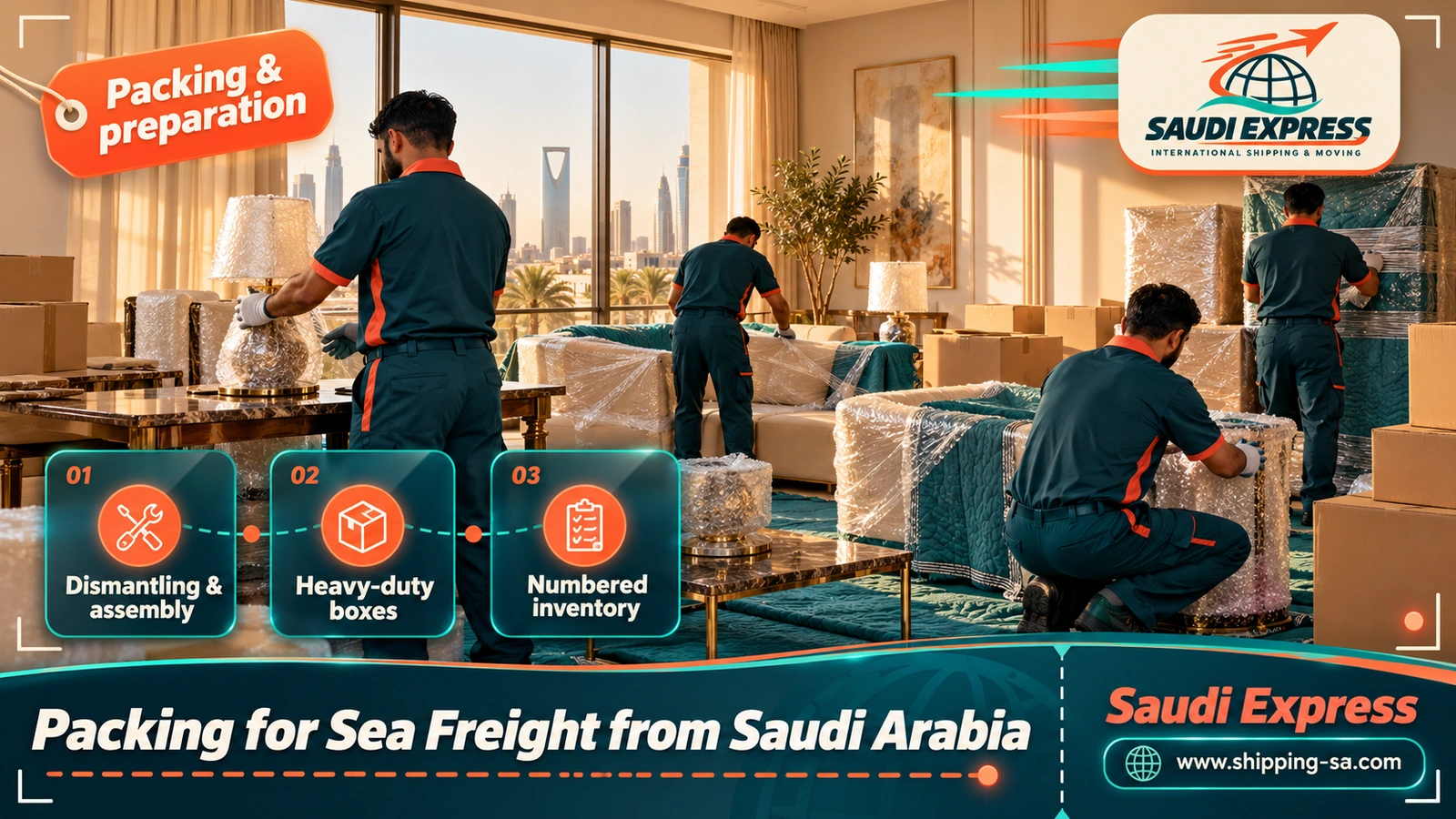
Sea packing is heavier than for a local move, because the voyage lasts weeks in sea humidity and the container may be lifted several times. We wrap wood in blankets then stretch film, crate glass and marble, cover sofas with a moisture barrier and drain and dry appliances. Then we stow the load with heavy items at the bottom and strap it so nothing moves as the ship rolls.
The inventory is central: every piece has a number and description on a list presented to customs at destination, and many countries exempt permanent returnees’ furniture from duty when that list and proof of change of residence are provided. If your home at destination is not ready, the furniture can stay packed through our furniture storage service until shipping.
Shipping cars by sea from Saudi Arabia
Cars go by sea in three ways: RoRo, where the car is driven onto a vehicle carrier and lashed on its decks, from SAR 6,030; inside a dedicated 20 ft container secured with straps; or in a shared 40 ft container holding two to four cars. The choice depends on the car’s value, the destination and RoRo availability on that route.
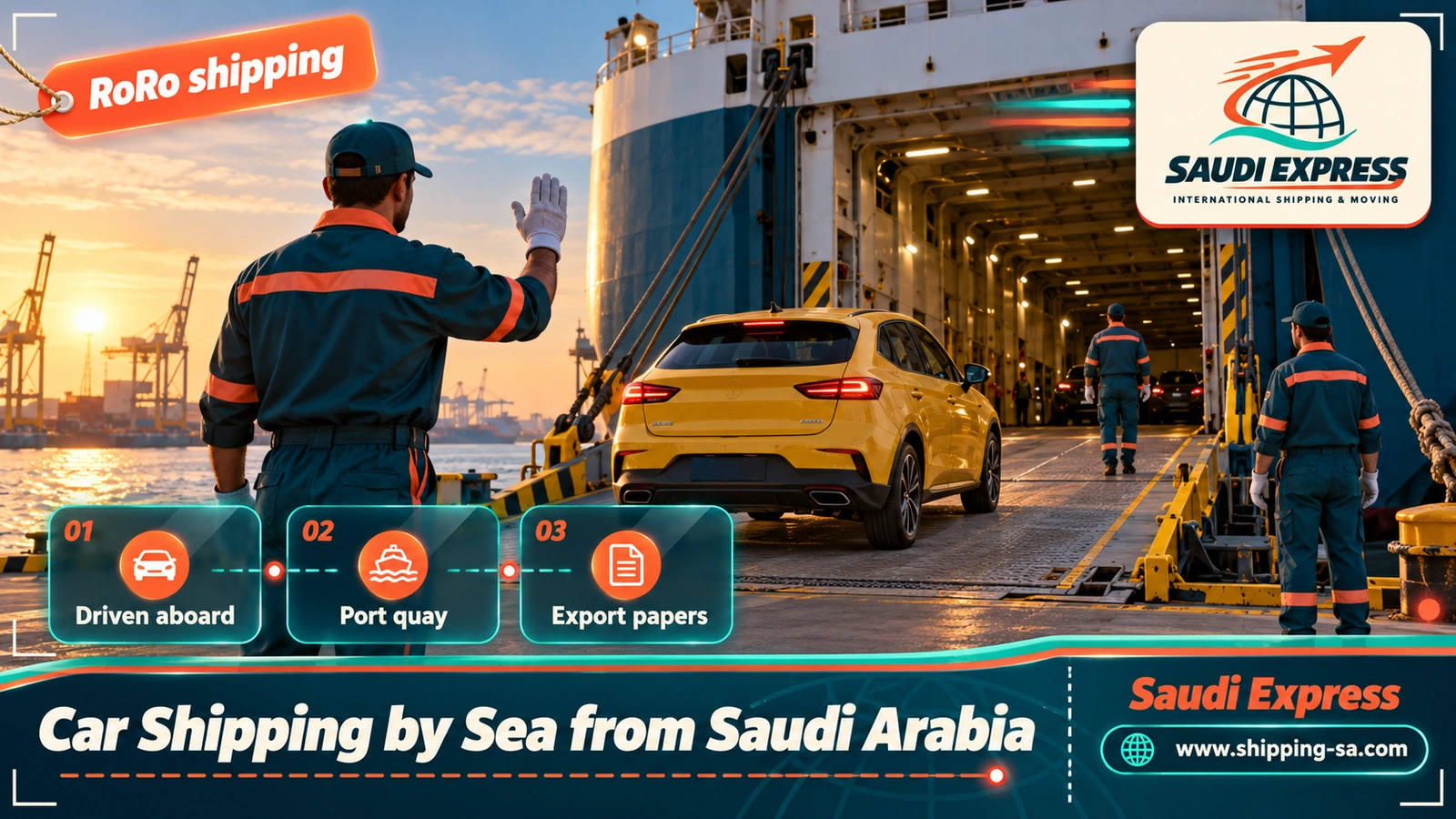
RoRo is cheaper for ordinary cars but allows nothing inside the vehicle, and the car must be driveable. A container suits luxury, classic and non-running cars and lets you ship some packed belongings with it in a dedicated box. In every case check the destination’s rules, as many countries set a maximum age for imported cars.
- Car papers: original registration in the owner’s name, the owner’s ID or iqama, and the shipping company’s letter.
- Export: the vehicle export procedure completed with the traffic department, with no outstanding fines.
- Preparation: low fuel, battery terminal disconnected in a container, personal items removed for RoRo.
- Destination: check the permitted age and import charges before shipping.
To compare all car shipping options, see our car shipping page.
Documents required in sea freight
The core sea freight documents are the bill of lading, the commercial invoice, the packing list, a certificate of origin when required, the export declaration filed on the FASAH platform, and the shipper’s ID or commercial register. Household furniture needs a detailed inventory and any exemption papers required at destination.
| Document | What it is | Prepared by |
|---|---|---|
| Bill of lading (B/L) | Receipt for goods loaded on the vessel and title to them | Shipping company |
| Commercial invoice | Value and description of the goods | Shipper |
| Packing list | Number of packages, weights, dimensions and contents | Shipper with the shipping company |
| Certificate of origin | Country where the goods were made | Chamber of commerce at the shipper’s request |
| Export declaration | Saudi customs declaration via FASAH | Saudi Express |
| Shipper ID or commercial register | Proof of the shipper’s capacity | Customer |
In commercial contracts, Incoterms decide who pays for what: under FOB the seller pays until the goods are loaded on the vessel at the Saudi port; under CIF the seller pays freight and insurance to the destination port; under EXW the buyer collects from the seller’s warehouse. Knowing the term in your contract prevents disputes over port charges at both ends.
Prohibited items and marine insurance
Normal sea freight excludes undeclared explosive and flammable materials, gas cylinders, weapons and ammunition, narcotics, and hazardous chemicals without approved classification and packaging. Declared dangerous goods, such as some industrial chemicals, ship under special procedures and classification, so ask before booking.
- Each country has extra prohibitions; some ban old used cars, certain medicines or wireless devices.
- Cash, gold, jewellery and original documents are not shipped inside containers.
- Fresh food ships only in reefer containers with the destination’s permits.
Marine insurance protects the value of your goods against voyage risks: sinking, fire, a dropped container and damage from transport accidents. All-risks cover protects against most hazards, while limited cover only handles major incidents. We recommend all-risks cover for furniture, cars and valuable goods, and we explain the exclusions before loading.
Consolidation warehouses and demurrage
Consolidation warehouses are where small shipments are gathered before loading into a shared container and sorted on arrival. We consolidate in Jeddah, Riyadh and Dammam, numbering and photographing every package before loading so each one reaches its owner without mix-ups.
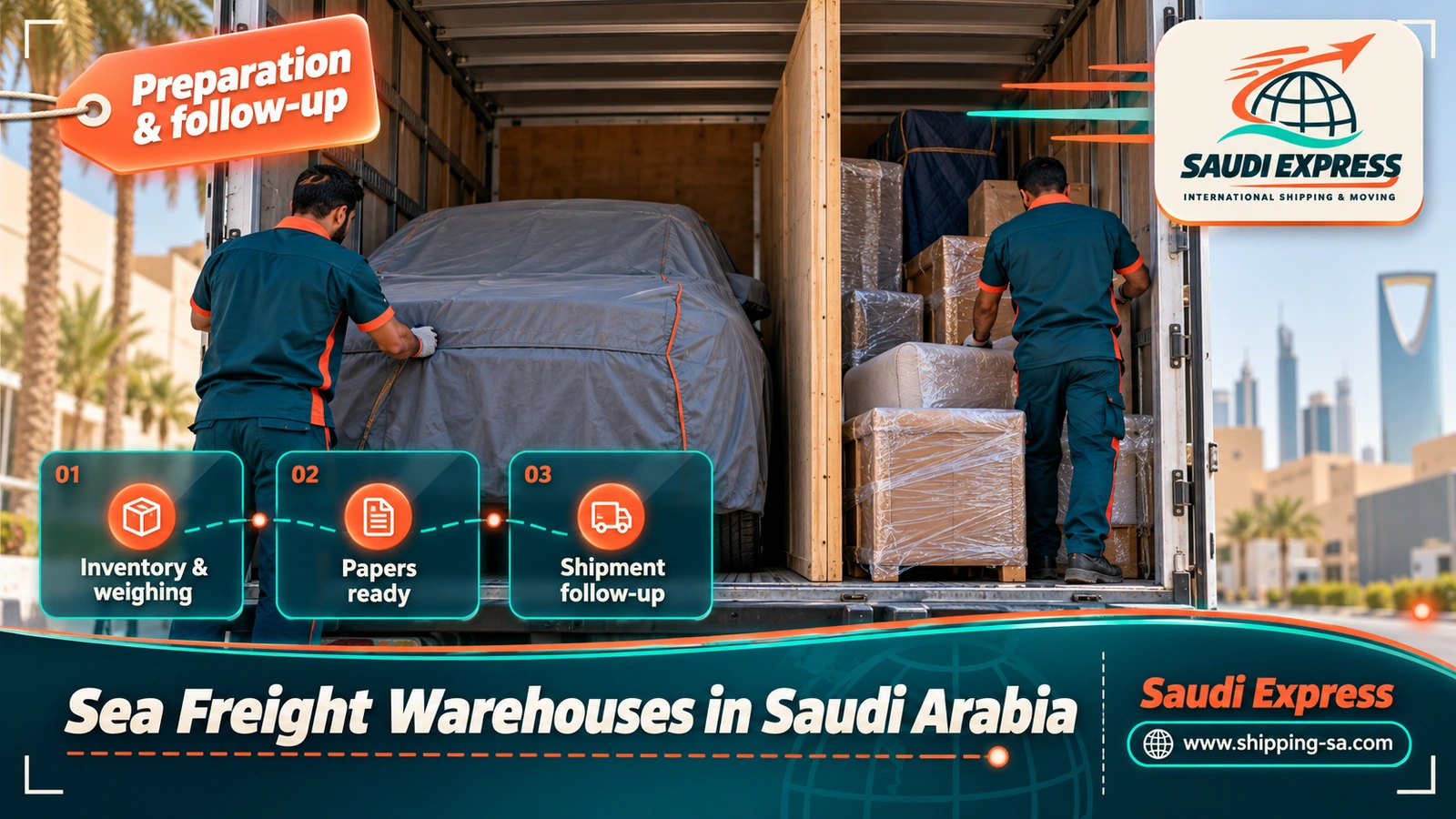
Ports allow “free days” during which a container sits without charge after arrival; after that daily demurrage begins, and there is also a deadline for returning the empty container to the line. Late papers and an absent consignee are the usual causes of these charges, so we send papers to the broker before the vessel arrives and follow up with the consignee on collection.
When is air freight better than sea?
Air beats sea when the shipment is small and high-value or urgent: papers, medicines, electronics, spare parts that are stopping a production line, trade samples. Air arrives in days rather than weeks, but it is charged per kilo or volumetric weight, so it becomes costly for large volumes.
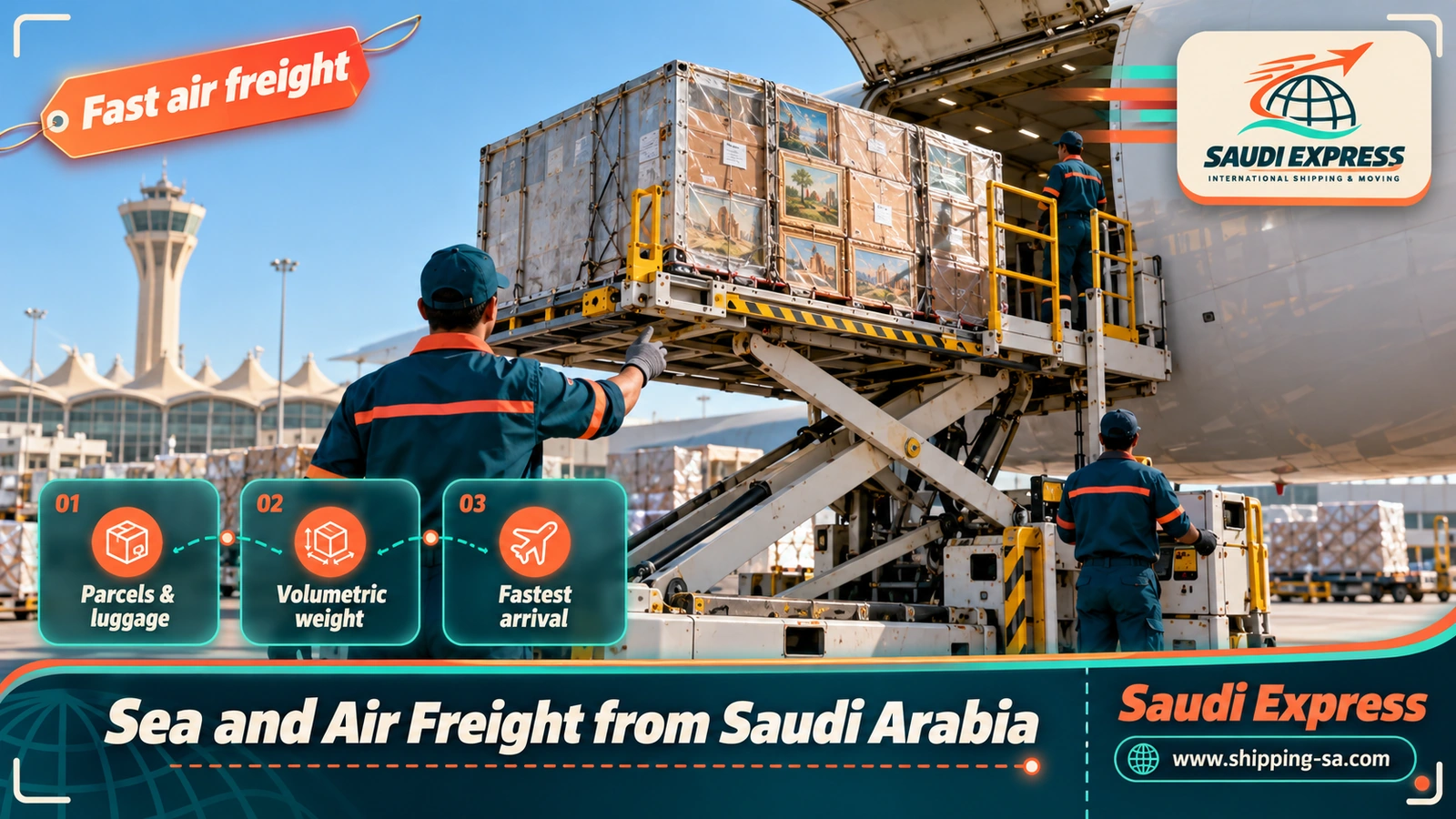
Air volumetric weight = length × width × height in centimetres ÷ 6000, so one cubic metre is billed as about 167 kg by air. A simple comparison: a cubic metre of clothing costs the price of one cubic metre in shared sea freight, but the price of 167 kg by air. Hence the usual advice to combine: urgent items by air, the rest by sea. Details are in our guide Air Freight Company in Saudi Arabia.
What happens at the destination port?
At the destination port the container is discharged and moved to the container yard, the broker files the customs declaration with the bill of lading, invoice and packing list, and customs decide how to inspect: by scanner, by opening the container and checking part of it, or by full inspection. Once any duties are paid, the container is released and taken to the warehouse or the address.
The original bill of lading or the line’s release is required to collect the container. With an original B/L, it must reach the consignee before the container does; with an electronic release, the line simply sends it to its agent at the destination port. We arrange the right method before sailing so a document never holds the container up.
Common mistakes in sea freight
- Late booking: vessels fill up in peak seasons, delaying sailing by a week or more.
- The wrong container type: heavy goods in a 40 ft that exceed the weight limit, or light goods in a 20 ft that cannot hold them.
- Poor stowage: an unlashed load shifts with the ship and gets damaged.
- An unrealistic invoice value: leads to re-valuation and a held container.
- Ignoring destination rules: a car over the permitted age or goods needing a conformity certificate.
- Late collection: demurrage and late return of the empty container.
People moving home permanently to their own country often benefit from duty-free used furniture, but each country sets its own conditions: a change-of-residence certificate, a minimum period abroad, or one appliance of each type. We review your country’s conditions before loading and write the inventory the way its customs accept.
Sea freight steps with Saudi Express
Sea freight with us follows these steps from request to delivery:
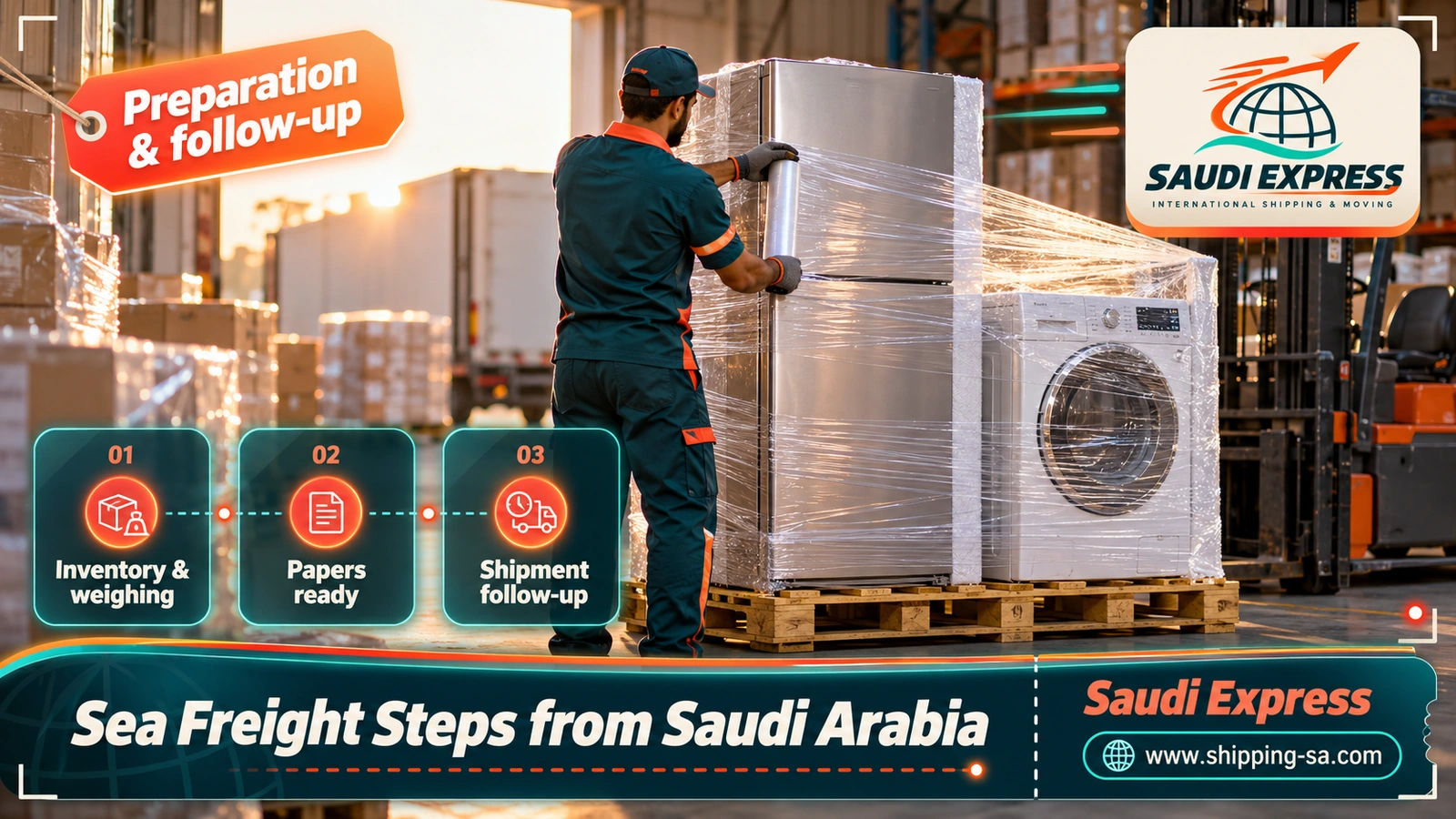
- Request: send the destination, type of goods, volume and pickup city to 0560533140.
- Offer: we suggest full or shared, the right port and sailing date, with an itemised price.
- Booking: we book vessel space and send you the list of required papers.
- Loading: at your home or warehouse for a full container, or at the consolidation warehouse for shared.
- Export: FASAH declaration, container delivered to port and B/L issued.
- Sailing and tracking: we send the B/L number, vessel name and expected arrival.
- Arrival and delivery: clearance at the destination port, then delivery to the address.
Tips for lower-cost, faster sea freight
The lowest-cost sea shipment is the one matched to the right container type, and the fastest is the one whose papers were complete before sailing. Our advice:
- Book at least two to three weeks ahead, as vessel space fills up in peak seasons.
- If your volume approaches 15 cubic metres, ask for the full-container price before shared.
- Describe goods precisely on the invoice; a vague description stops clearance.
- Check destination rules before shipping a car, appliances or medicines.
- Take all-risks insurance for furniture and valuable goods.
- Send papers to the consignee before the vessel arrives to avoid demurrage.
Your container is waiting for its sailing
Send the destination, type and volume of your shipment, and we will reply with the price and the next vessel from Jeddah or Dammam.